Archive for the 'taxes' Category

Pay No Attention to the Man Behind the Curtains

Alan Reynolds at Cato asks “How’s Obama Going to Raise $4.3 Trillion?

Altogether, Mr. Obama is promising at least $4.3 trillion of increased spending and reduced tax revenue from 2009 to 2018 — roughly an extra $430 billion a year by 2012-2013.

How is he going to pay for it?

Read the whole thing for an overview of what Obama is promising in inscreased spending and loss of tax revenues and how his rational for paying for it falls far short of the goal. How will we pay for all this? It’s something I’ve wondered for a long long time and have only found hand waving about corporate loopholes and better efficiencies savings that seem absurd on their face.

That leaves 3 options as I see it. We will do one or some combination of

  1. Increase the national debt
  2. Raise taxes
  3. Cut Spending

Increasing the national debt may not be as politially feasible in the near future as it has been in the past (at least I hope), so it’s clear that can’t account for all of it. I’m not sure how much more the democrats will be able to tax the rich and corporations. I mean, they might try, but I don’t think it will give them the returns they would hope for. So that leaves raising taxes on the rest of us and cutting spending. Any whats the only part of the budge the democrats have been known to favor spending cuts for? The military.

Sphere: Related Content

Is Income Tax Becoming Too Progressive?

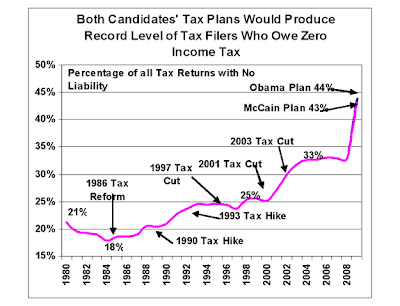
Under McCain and Obamas tax plans 43% and 44% would pay no income tax respectively

Under McCain and Obama's tax plans 43% and 44% would pay no income tax respectively

Fewer and fewer people are paying income tax and even less will be with either candidates tax plan. I don’t think this would be such a problem if we didn’t have such high spending, growing entitlements, and if so many of these zero income tax filers weren’t getting additional handouts from the government (especially under Obama’s tax “cuts” ie. handouts).

It has been said by an unknown author “[Democracy] can only exist until the voters discover that they can vote themselves largesse from the public treasury. From that moment on, the majority always votes for the candidates promising the most benefits from the public treasury…” and this is where we’ve been heading for awhile. I think just as a tax plan can be too regressive, it can be too progressive in that it places too high a burden on “the rich” resulting in them leaving (atlas shrugs) or seeking tax shelters, and at the same time having too much of the population with no civic tax obligation leaving them no incentive to constrain public spending (hey, it’s not their money right?)

(HT Greg Mankiw)

Sphere: Related Content

Hooray for Mental Health!

If you support the Paulson bailout plan that is. The New York Times has coverage.

The Senate proposal would cost more than $100 billion and extend and expand many individual and business tax breaks, including tax credits for the production and use of renewable energy sources, like solar energy and wind power.

The bill would also extend the business tax credit for research and development, expand the child tax credit, protect millions of families from the alternative minimum tax and provide tax relief to victims of recent floods, tornadoes and severe storms.

In a delicious bit of soon to be civics geek trivia, the Senate worked around the Constitutional restrictions against voting on tax legislation not already considered by the House by attaching the bailout plan along with a tax extender bill to the Mental Health & Addiction Act (which passed the House several months ago).

You gotta love our government.

In addition to the Paulson plan details, various tax cuts and dealing with the AMT it includes a very helpful proposal, increasing government insurance on bank deposits from 100k to 250k.

Sphere: Related Content

Lone accountant takes on IRS and wins

And millions of us may benefit.

The dispute arose when more than 30 mutual life insurance companies became publicly traded corporations in the late 1990s and earlier this decade, in a process known as “demutualization.”

Mutual companies are owned by their policyholders, so the companies provided stock and cash to compensate them for the loss of their ownership interests when they went public.

All told, roughly 30 million policyholders received distributions, Ulrich estimates. MetLife Inc. provided over $7 billion of stock to about 11 million policyholders when it went public in 2000, while Prudential distributed $12.5 billion in stock to another 11 million.

The IRS held that the recipients hadn’t paid anything for the shares and owed taxes on the full amount when the shares were sold. Cash distributions also were fully taxable, the IRS said.

That didn’t sound right to Ulrich, 72, an accountant for 49 years. He began researching the issue in 2001, when he received shares from two companies, Prudential and Indianapolis Life.

Ulrich concluded that policyholders had paid for their ownership rights through their premiums so the distributions should have been tax-free.

Funny, a family member gave me some shares he inherited from Met Life’s demutualization just last night to help him with. The man is a hero in my book. The IRS’s position was illogical, but they often make calling them on such matters too burdensome for most to fight. Good for him.

Sphere: Related Content